Commercial Washroom Hygiene: What Your Cleaning Contract Should Cover
Munyovi Victor IndiaziThe four jobs a washroom specification has to cover, and the ones that usually get left out.
Nobody tours a building and compliments the washrooms. They only ever notice the other kind, and when they do, it colours what they think about everything else — the offices, the canteen, the company. A warehouse floor that is slightly scuffed reads as a working building. A washroom that is not right reads as neglect, and it is personal in a way that no other room in a building manages to be.
Which is why washrooms generate more complaints than any other part of a cleaning contract while occupying a tiny fraction of the floor area. This guide sets out what commercial washroom hygiene actually involves, the bits that routinely get left out of a specification, and how often the work genuinely needs doing.
What does washroom hygiene actually cover?
Four separate jobs that often get written up as one line on a schedule.
There is cleaning — the pans, urinals, basins, floors, partitions and mirrors. There is hygiene, which is a different thing: the touch points, the waste, and the places where bacteria actually live rather than where dirt is visible. There is consumables — soap, paper, hand drying — and keeping them stocked. And there is sanitary waste, which is regulated and cannot be treated as general rubbish.
A contract that says "clean washrooms daily" has specified the first of those four and left the other three to chance. That is where most washroom problems start.
Why does a washroom still smell after it has been cleaned?
Because the smell is almost never coming from the surfaces that got cleaned.
Urine finds its way into three places a routine clean does not reach: the grout and the joint where the floor meets the wall, the gap behind and around the base of the pan, and inside the pipework and traps. Once there it dries, and the salts it leaves behind are alkaline. General-purpose cleaners are alkaline too, so they do almost nothing to it — you can clean the room thoroughly, leave it smelling of detergent, and have the smell return within an hour as the air warms up.
What breaks those deposits down is an acidic descaler or an enzymatic treatment, applied to the floor junction and around the pan base rather than to the ceramic, and given time to work. It is the same chemistry problem we describe in why your toilet still smells after cleaning, and in a commercial washroom with real footfall it needs to be a scheduled periodic task, not an occasional response to a complaint.
Where is the actual hygiene risk?
On the things people touch on the way out, not on the things they look at.
The door handle, the lock on the cubicle, the flush plate or handle, the tap, the soap dispenser button and the dryer or towel dispenser are the surfaces that take hand contact from every single user. They are small, they are quick to do, and they are the first thing dropped when a cleaner is behind schedule, because nobody inspecting the room afterwards looks at a lock.
A pan that looks clean and a door handle that has not been touched since yesterday is exactly the wrong way round. Touch points should be named individually in the specification so they are a task rather than an assumption.
Why is the floor more important than the pan?
Because it holds what the pan does not.
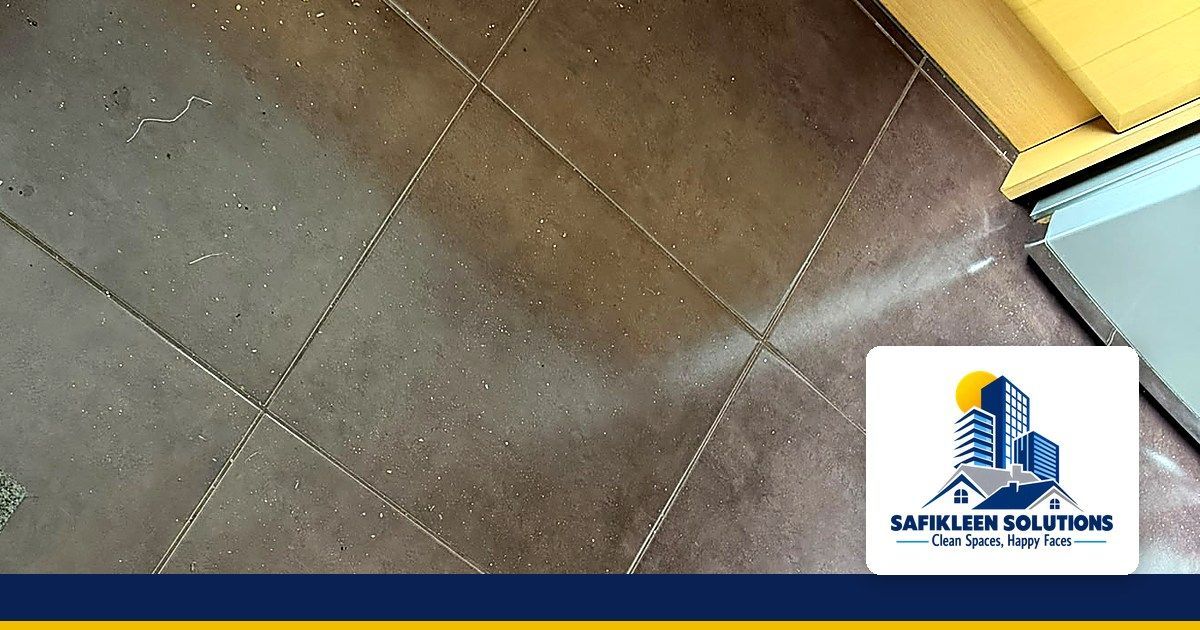
Washroom floors are usually tiled with porous grout, and the area within a metre of a urinal or pan takes splash all day. The grout absorbs it, the skirting junction collects it, and a flat mop bridges straight over the grout line without touching the bottom of it. Worse, mopping with a single bucket spreads a thin film of what was in the splash zone across the entire floor and leaves it there to dry.
The fix is unglamorous: a separate mop and solution for washrooms that never goes anywhere else, water changed per room rather than per floor, and a periodic machine scrub or grout treatment that actually gets into the joint. The wider principle is in why a mopped floor still looks dull.
What about urinals and scale?
Urinals are where hard water and urine combine into something neither alone would produce.
In a hard water area, calcium from the supply reacts with urine salts to form a hard scale that builds inside the trap, the outlet and the sparge pipe. It restricts flow, it holds odour, and left long enough it blocks the drain entirely — at which point it is a plumber's problem rather than a cleaner's. Waterless urinals avoid the flushing water but still need their cartridges or traps serviced on schedule, and they fail noticeably when that slips.
Either way the answer is a descaling schedule with a frequency against it, not a reaction when something stops draining. Monthly is a reasonable starting point in a hard water area with steady use.
Why does colour coding matter?
Because it is the only practical way to stop a washroom cloth ending up on a kitchen worktop.
The standard four-colour system used across UK cleaning is red for washrooms and sanitary fittings, blue for general lower-risk areas such as offices, green for food preparation and bar areas, and yellow for clinical or higher-risk work. Cloths, mops, buckets and often gloves follow the same code, and the point is that nobody has to remember anything — the colour does the remembering.
It only works if the equipment is genuinely separated and laundered separately, and if there is enough of it that a cleaner under time pressure is never choosing between using the wrong colour and not doing the task. Ask to see the system rather than ask whether there is one.
Who keeps the consumables stocked?
Whoever the contract says, and if the contract does not say, nobody.
Running out of soap or paper generates more complaints than any amount of grubby grout, because it is immediate and personal and it affects somebody at the worst possible moment. It is also the easiest thing in the whole specification to get right, and the most commonly left vague.
Three things need writing down: who supplies the consumables, who restocks them and how often, and what the minimum stock level on site is. A dispenser that is refilled only when a cleaner notices it empty will be empty regularly. One that is topped up at every visit against a par level will not.
How should sanitary waste be handled?
As offensive waste, separately from general rubbish, with a documented collection.
UK businesses have a duty of care for the waste they produce, and sanitary waste cannot simply go into the general stream. In practice that means lockable units serviced on a scheduled cycle by a licensed contractor, with transfer documentation kept. The Workplace (Health, Safety and Welfare) Regulations place the obligation to provide suitable, properly maintained sanitary facilities on the employer, and disposal is part of that rather than an optional extra.
Two practical points. Units should be in every cubicle rather than one shared bin in the corner, because a unit people have to walk to is a unit that does not get used. And provision in male and gender-neutral cubicles is increasingly expected, not least because people with continence needs or who are undergoing treatment exist in every workforce.
Hand dryers or paper towels?
The honest answer is that it matters less than whether people dry their hands at all.
Wet hands transfer far more bacteria than dry ones, so the single most important thing is that the drying method is available, working and quick enough that people use it. Paper towels dry fast and let people open the door with the towel, which helps on the touch point that matters most. Dryers remove consumable cost and waste volume but are slower, and a queue at a dryer means people leave with wet hands.
From a cleaning point of view each brings its own job: paper means a bin that fills fast and must be emptied at every visit, and dryers mean a unit whose grille and nozzle collect grime and need wiping rather than ignoring.
Why does ventilation decide so much?
Because a washroom that cannot dry out between uses will keep producing the problems you are paying someone to remove.
Extract fans that have stopped working, are blocked with dust, or were never adequate for the number of cubicles leave humidity sitting in the room. That feeds mould in silicone and grout, keeps odour in soft surfaces, and makes every cleaning result shorter-lived than it should be. A fan that is not running is a facilities issue rather than a cleaning one, but it is a cleaner who notices first, and a good contractor reports it rather than quietly cleaning around it.
How often should a commercial washroom be cleaned?
By footfall rather than by habit, and for most sites more than once a day.
A small office washroom used by a dozen people generally needs a thorough daily clean. A washroom serving a busy floor, a school, a gym or a site with shift changes needs a full clean plus one or more checks during the day — restock, empty, wipe touch points, deal with anything obvious. High-traffic public-facing washrooms need checks on an hourly or two-hourly cycle with a signed record.
On top of that sits periodic work: descaling, grout treatment, a machine scrub of the floor, cleaning behind and under the sanitaryware, and the parts of the room above head height. Quarterly is a common cycle, monthly where use is heavy. The same question for the rest of a building is covered in how often your office should really be cleaned.
What should be written into the specification?
Each of the four jobs above, with a frequency and an owner against every line.
That means the cleaning tasks themselves; the touch points named individually; descaling and grout work as scheduled periodic items; consumables with a supplier, a restock frequency and a par level; sanitary waste with a service cycle and a named contractor; and the checks, with whatever record proves they happened. It should also say what happens outside the schedule — who to call for a blocked pan or a flood, and how quickly somebody will be there.
If a task is not on the list with a frequency against it, it is not in the price, and the first anyone knows about it is a complaint. We set the wider principle out in what should be in a commercial cleaning specification.
Do the checks need to be recorded?
If you want them to keep happening, yes.
A signed check sheet on the back of the door is the oldest system there is and it still works, because it tells users somebody is responsible and it tells the contractor somebody is looking. Digital equivalents do the same job with a timestamp and are harder to backfill. Either way the value is the same: a check that leaves no trace is a check nobody can be held to, and in an audited environment it is a gap in your paperwork rather than just an untidy room.
Commercial washroom cleaning in Peterborough
SafiKleen Solutions maintain washrooms as part of contract cleaning for offices, schools, warehouses, gyms and trade premises across Peterborough and the surrounding area, alongside office cleaning, industrial cleaning and pest control.
In practice that means washroom equipment that is colour-coded and kept separate, touch points written into the schedule as named tasks rather than assumed, descaling and grout work on a cycle instead of on complaint, consumables restocked to a par level at every visit, and sanitary waste on a documented collection. It also means telling you when the problem is not cleaning at all — a failed extract fan, perished silicone, a waste pipe that needs a plumber — rather than cleaning around it month after month.
If your washrooms smell shortly after they have been cleaned, if consumables keep running out, or if you are putting a contract out and want the washroom section to be right, that is the conversation to have. You can see the contract cleaning service or the full range of what we cover, or get in touch to arrange a walk round and a written quote.
Ready to work with SafiKleen Solutions Limited?
Let's connect! We’re here to help.
Send us a message and we’ll be in touch.
Or give us a call today at 01733 602 904
Agency Contact Form
More Marketing Tips, Tricks & Tools