Why Is Your Gas Hob Flame Yellow? A Burner Deep Clean, Before and After
Munyovi Victor IndiaziA yellow flame usually means blocked burner ports, not a broken hob. What causes it, how to clean a burner properly, and when to call a Gas Safe engineer.

The burner at the top of this page came off a hob in Peterborough. The orange crust on it is not rust, whatever it looks like from a distance. It is dinner: boiled over, baked on, and then cooked again every single time the hob went on afterwards.
Nobody had done anything wrong. A hob gets like that slowly, one layer at a time, and because it happens slowly it never looks quite bad enough to deal with on any particular Tuesday. What usually gets noticed first is not the burner at all. It is the flame.
The short answer
A yellow or orange gas flame normally means the burner is not getting enough air to burn its gas properly. On a domestic hob the most common cause by a distance is blocked flame ports - the small slots around the rim of the burner crown, packed solid with carbonised spillage.
Cleaning the burner clears it in most cases, and this page explains exactly how. But if the flame is still yellow once the burner has been properly cleaned, dried and refitted, stop there and call a Gas Safe registered engineer. A flame that will not burn blue can mean incomplete combustion, and incomplete combustion produces carbon monoxide.
What the flame is actually telling you
The colour of a gas flame is a reasonable proxy for how well it is mixing with air, and it costs nothing to look.
A flame that is working properly
Crisp, mostly blue, sharply defined, sitting steady on the burner and not wandering. That is gas and air meeting in roughly the ratio the burner was designed for, and burning more or less completely. You may see a small soft tip; that is normal.
A yellow, orange or lazy flame
Soft-edged, taller than it should be, orange or yellow, drifting about rather than sitting still. That is a shortage of air. The gas is burning incompletely, which is why it deposits soot - and sooty black marks on the base of your pans are the same message arriving by a different route.
The other signs worth knowing
Flame colour is one of several warning signs that a gas appliance is not burning properly. The others are worth committing to memory:
- Lazy yellow or orange flames instead of crisp blue ones
- Black or sooty marks on or around the appliance
- A pilot light that keeps going out
- More condensation than usual in the room
Carbon monoxide itself has no colour, no smell and no taste, which is precisely why these indirect signs matter. The symptoms of carbon monoxide poisoning - headaches, dizziness, shortness of breath, nausea, and in serious cases collapse and loss of consciousness - look a great deal like a virus or ordinary tiredness, so they are very easy to explain away.
What was actually on this burner
Burnt-on hob residue is mostly sugar, starch, fat and salt. Each of those behaves differently under heat. Sugars caramelise and then carbonise. Fats polymerise into a varnish that is far tougher than the grease it started as. Salt simply stays put, and salt in the company of moisture and heat is why a cast burner crown ends up that rust-orange colour rather than merely black.
So what you are looking at in the first clip is not one substance but several, laid down in layers over months, each one baked harder by the next cooking session. That is also why wiping does nothing to it. There is no stage at which this material is soft.
Why the ports block in the first place
Every pan that boils over sends liquid down the outside of itself and onto the hob. Some of it runs away across the surface, which is the part people wipe. The rest runs into the burner bowl and sits against the crown, which is the part nobody can see.
The flame ports are the last place anything gets cleaned, for the straightforward reason that you cannot see into them while the burner is assembled. They are also the worst possible place for residue to collect, because each port is sized deliberately. Narrow one and you change how much gas comes through it. Narrow all of them and you change how the whole burner behaves.
There is a second effect that catches people out. A partly blocked burner does not fail; it just quietly gets worse at its job. Pans take longer. The hob seems less powerful than it used to be. Nobody connects that to cleaning, because nothing has broken.
How to clean a gas hob burner properly
This is the sequence we use, and none of it involves touching the gas side of the appliance.
1. Let it go completely cold, then take it apart in order
Pan supports off first, then the burner cap - the flat disc on top - then the crown underneath it. Lay them out in the order they came off, and if your hob has burners of different sizes, keep each set together. Caps and crowns are not interchangeable between burners, and a cap sitting on the wrong crown will give you a poor flame even when everything is spotless.
2. Soak rather than scrape
Hot water and washing-up liquid, and time. Half an hour minimum, longer for anything like the burner in these photographs. The whole point of soaking is to turn that baked varnish back into something soft enough to lift, because every minute you save by scraping instead, you pay for in scratches that give the next lot of residue something to key into.
Avoid wire wool and metal scourers on the crown. A nylon brush, a plastic scraper and patience will get there.
3. Clear the flame ports one at a time
This is the part that actually fixes the flame. Work round the crown with a soft brush, and for anything stubborn use a wooden cocktail stick or a nylon bristle.
Never use a needle, a pin, a drill bit or a paperclip. Reshaping a port is considerably worse than leaving it blocked: a blocked port burns nothing, but an enlarged or distorted one changes the gas-to-air mixture for the whole burner permanently, and you cannot put it back.
4. Dry everything completely
Completely, not nearly. Water left in a port or under a crown will sit against cast metal and start corroding it, and a damp crown refitted onto a hob is how you get that orange staining back faster than you lost it. Leave the parts somewhere warm and airy for an hour before they go anywhere near the hob.
5. Refit it the right way round
Most crowns have a notch, a lug or a flat that locates against the burner base so that the ports line up where the manufacturer intended, and so the crown sits clear of the ignition electrode. If a crown will not sit flat, it is in the wrong place or on the wrong burner - do not press it down. Then light each burner and look at the flame. It should be blue, even all the way round, and steady.
The parts you should not clean
Three things sit in that burner bowl that are not yours to work on, and all three are visible in the video at the top of this page:
- The ignition electrode - the small white ceramic peg beside the burner. It makes the spark. Wipe around it gently if it is greasy, but do not bend it, soak it or lever anything against it; its gap to the burner is set.
- The flame failure device - the thin metal probe next to the electrode. It senses that a flame is present and shuts the gas off if it goes out. It is a safety device, and it needs to stay exactly where it is.
- The gas injector - the small jet in the middle of the burner base that the crown sits over. Nothing goes in it. Not a brush, not a pin, not a cloth.
If any of those three is damaged, dirty beyond a gentle wipe, or you are simply not sure, that is an engineer's job.
How often do hob burners need this?
For a normal household, lifting the crowns off and soaking them two or three times a year keeps them from ever reaching the state in these photographs. The surface of the hob still wants wiping after every use, and anything that boils over is better dealt with once it has cooled than left for the weekend.
Busier kitchens need it more often. A commercial hob, or a family hob that cooks properly twice a day, is realistically a monthly job. And if a hob has been neglected for a year or more, the first clean is a different sort of task altogether - that is the one people tend to hand over, and it sits inside a wider kitchen deep clean rather than being a job on its own.
When it stops being a cleaning job
We clean the removable parts. We do not work on gas appliances, and no cleaning company should tell you otherwise. The line is simple: anything that comes off the hob in your hands is cleaning, and anything involving the gas supply, the injector, the electrode, the flame failure device or the appliance's safety is work for a Gas Safe registered engineer.
Call an engineer if the flame is still yellow after a proper clean, if a burner keeps going out on its own, if you can see black or sooty marks around the appliance, or if there is noticeably more condensation in the kitchen than there used to be.
If you suspect carbon monoxide, treat it as an emergency. Switch the appliance off, open doors and windows, leave the property, and call the National Gas Emergency Service free on 0800 111 999, which is staffed around the clock. Seek medical help as well, because fresh air alone does not treat exposure. A carbon monoxide alarm in the kitchen costs very little and does the one thing your senses cannot do for you.
None of that is a reason to be nervous about a gas hob. It is a reason to look at the flame occasionally, and to get the appliance serviced annually by a Gas Safe registered engineer.
Hob and kitchen deep cleaning in Peterborough
SafiKleen Solutions deep clean kitchens across Peterborough, Stamford and the surrounding area, domestic and commercial. Hobs, burner crowns and caps, extractors and filters, oven interiors, and the bits around them that ordinary cleaning never reaches.
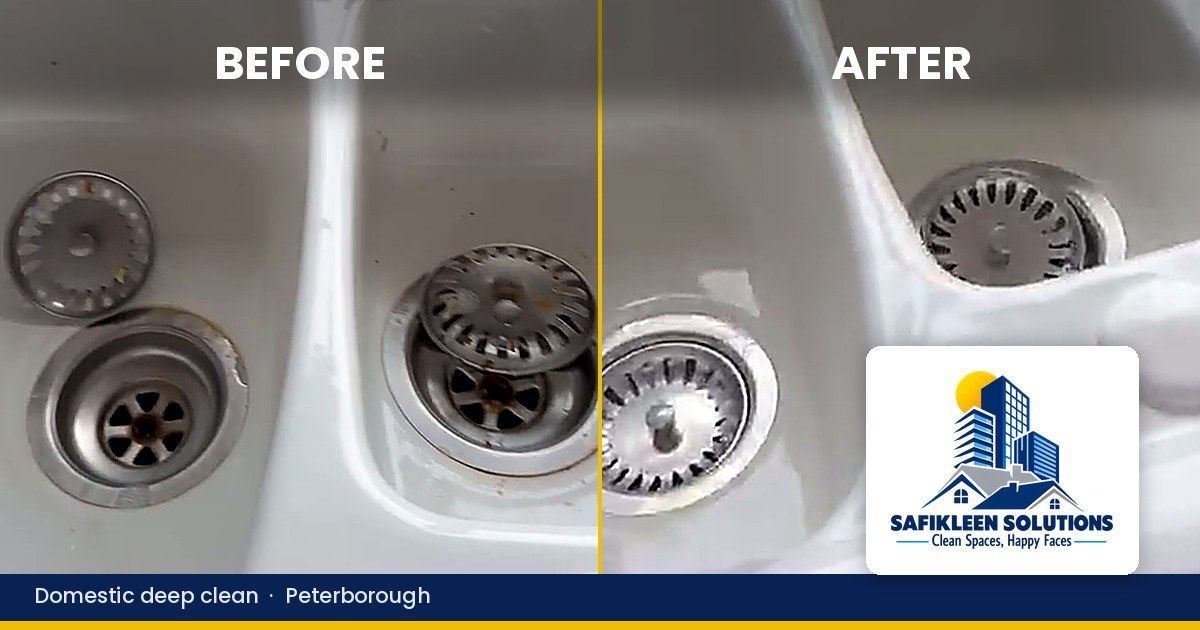
It is the same thinking as our kitchen sink deep clean case study: the dirt that matters is almost never the dirt you can see. If you are moving out, a hob in the state of the one in these photographs is one of the most reliable ways to lose part of a deposit, which is why it has its own line on our end of tenancy cleaning checklist.
Get in touch and tell us what state the kitchen is in. We would rather quote off an honest description than a hopeful one.
Frequently asked questions
Why is my gas hob flame yellow instead of blue?
Almost always because the burner is not getting enough air, and on a domestic hob that usually means the flame ports around the burner crown are blocked with burnt-on spillage. Clean the crown properly and the flame normally returns to blue. If it does not, stop and call a Gas Safe registered engineer.
Is a yellow flame on a gas hob dangerous?
It can be. A yellow flame indicates incomplete combustion, and incomplete combustion produces carbon monoxide, which you cannot see or smell. One briefly yellow flame as something boils over is not an emergency. A burner that consistently burns yellow needs dealing with, and if it stays yellow after cleaning it needs an engineer rather than another clean.
How do I unblock the flame ports on a gas hob?
Take the crown off once the hob is cold, soak it in hot soapy water for at least half an hour, then work round the ports with a soft nylon brush or a wooden cocktail stick. Dry it completely before refitting. Never clear a port with anything metal - a needle or pin will widen it and permanently change how the burner mixes gas and air.
Can gas burner parts go in the dishwasher?
Check the manual first, because it depends what they are made of. Cast iron caps and crowns generally should not: dishwasher detergent strips their coating and they come out looking dull and then start to rust. Enamelled steel parts are often fine. When in doubt, wash by hand - it takes longer but it never ruins anything.
Will oven cleaner shift burnt-on hob residue?
On some parts, yes, but read the product carefully. Caustic oven cleaners can attack aluminium and damage enamel and anodised finishes, which is exactly what a lot of burner caps are made of. For most hobs, a long soak in hot soapy water does the same job with none of the risk, and it is kinder to whoever has to breathe in the kitchen afterwards.
My pans have black marks underneath. Is that related?
Yes, very likely. Sooting on the base of a pan is deposited carbon, and carbon is what a flame leaves behind when it is burning incompletely. It is the same signal as the yellow flame, just written on your cookware instead. Clean the burner and the marks should stop appearing.
Ready to work with SafiKleen Solutions Limited?
Let's connect! We’re here to help.
Send us a message and we’ll be in touch.
Or give us a call today at 01733 602 904
Agency Contact Form
More Marketing Tips, Tricks & Tools