How Much Does Commercial Cleaning Cost in Peterborough?
Munyovi Victor IndiaziWhat commercial cleaning costs in Peterborough, how contractors arrive at the number, and what to check before you compare two quotes.
Almost nobody in this industry publishes prices, and the reason given is always the same: every building is different. That is true. It is also convenient, because it means you cannot compare anybody until you have sat through three site visits.
So here is the honest version. Below are the rates commercial cleaning actually gets bought and sold at in and around Peterborough, how contractors arrive at a number, and the handful of things that genuinely move it. None of it replaces a site visit. All of it should stop you walking into one blind.
The short answer
For ongoing commercial and contract cleaning in the Peterborough area, expect roughly:
- £15 to £25 per cleaner per hour for a regular contract, with most quotes landing between £18 and £22
- £20 to £35 per hour for one-off and deep cleans
- £25 to £40 per hour for an after-builders or end-of-build clean
- £0.15 to £0.40 per square metre per visit where a job is priced by area rather than by time
- £400 to £800 a month for a small office under about 100 square metres cleaned five evenings a week
London and the South East sit higher, commonly £20 to £40 an hour. Peterborough sits below that, broadly in line with the national range. If a quote you are holding is well outside these figures in either direction, that is worth a question rather than a decision.
The three ways a cleaning contract gets priced
Every quote you receive is one of these three, even when it arrives as a single monthly figure with no workings.
By the hour
The most common, and the most transparent. The contractor estimates how long the work takes, multiplies by an hourly rate, and that is your price. Its weakness is that it pays for attendance rather than outcome: if the specification is vague, you are buying a person standing in your building for two hours, not a clean building.
By the visit
A fixed price per clean, whatever it takes. Better for you in principle, because the risk of a slow night sits with the contractor. It only works where the scope is written down properly, otherwise every extra becomes a conversation.
By the square metre
Used mainly on larger or multi-floor buildings, typically £0.15 to £0.40 per square metre per visit. It is the fastest way to sanity-check a quote you already have: measure the cleanable area, divide the price per visit by it, and see where the number falls.
Six things that actually move the price
1. Frequency
Counter-intuitively, cleaning more often usually costs less per visit. A building cleaned five nights a week never gets far from its baseline, so each visit is short. The same building cleaned once a week needs longer every time, because seven days of soil has to come off instead of one.
2. What the specification actually says
This is where most of the price difference between two quotes hides. Clean the kitchen can mean wiping the worktops, or it can mean worktops, fronts, inside the microwave, the fridge seals and descaling the kettle. Two contractors can quote the same building honestly and be forty per cent apart because they read that line differently.
3. Floor type and area
Carpet is quick nightly and expensive periodically. Hard floors are the reverse: fast to mop, but they need buffing, and eventually stripping and resealing, which is a separate line. Safety flooring in a kitchen or a washroom takes longer per square metre than anything else in the building.
4. Washrooms and consumables
Washrooms are the most labour-intensive square metres you own. Then there is the question of who buys the soap, hand towels, bin liners and toilet roll. If the contract does not say, you will find out in month three. Consumables supplied by the contractor typically add somewhere in the region of ten to fifteen per cent to a monthly figure, and are worth having priced separately so you can see it.
5. Access and hours
Work between about 6am and 8pm is ordinary. Anything that needs a cleaner on site at 4am, at a weekend, or escorted through a secure area costs more, because it is harder to staff reliably. Out-of-hours work also needs key-holding and alarm responsibility settled, which is sometimes a separate charge.
6. Periodic and deep-clean work
Carpet cleaning, floor stripping, high-level dusting, window cleaning and kitchen deep cleans are periodic, not nightly. Some contractors fold an allowance into the monthly fee; others quote them as they fall due. Neither is wrong, but a monthly figure that includes periodics is not comparable to one that does not.
What is usually in the price, and what is not
Normally included: labour, supervision, employer liability and public liability insurance, standard cleaning chemicals and equipment, colour-coded cloths and mops, and basic reporting.
Normally extra: consumables, periodic deep cleans, specialist floor treatments, window cleaning above ground level, waste removal beyond ordinary bin emptying, and anything described as a reaction to an incident rather than a routine task.
Why the cheapest quote is usually the dearest
The arithmetic here is not complicated, and it is worth doing before you sign anything.
From 1 April 2026 the National Living Wage is £12.71 an hour for workers aged 21 and over. On top of that wage, an employer pays National Insurance, holiday pay, pension contributions, insurance, equipment, chemicals, supervision, travel and management time. That is before a penny of profit.
Which means a contractor quoting you £14 an hour is not being clever about overheads. One of three things is happening: the hours on site are shorter than the ones on the quote, the work is being done by someone being paid improperly, or the price is an introductory figure that will move at the first review. All three end the same way, usually around month four, with you re-tendering the contract you only just signed.
The useful question is not what is your hourly rate but how many hours will be on site, and doing what.
How to compare two quotes properly
- Convert both to a price per visit and a price per hour on site, whatever format they arrived in
- Check they cover the same square metres, including stairs, corridors and store rooms, which get left out surprisingly often
- Check whether consumables are in or out, and at whose cost
- Check whether periodic work is included, excluded, or simply unmentioned
- Check the specification sets an order of work and a frequency per task, not just a visit count
- Ask what happens when a cleaner is off sick, and get the answer in writing
If one quote is materially cheaper after all that, it is cheaper for a reason you can now name. That is a decision. Before that, it is a guess.
Rough costs by premises type
Guide figures only, before VAT, for the Peterborough area:
- Small office, up to about ten desks, three visits a week: around £55 to £150 a week
- Medium office, ten to fifty desks, cleaned every weekday: around £180 to £500 a week
- Small office under 100 square metres, five evenings a week including consumables: around £400 to £800 a month
- Schools: priced per site after a survey, because term-time patterns, hall space and washroom ratios vary too much to generalise
- Industrial units and warehouses: usually priced by area, at the lower end per square metre, with a separate line for mezzanines and high-level work
- Retail: priced on footfall and opening hours more than on floor area
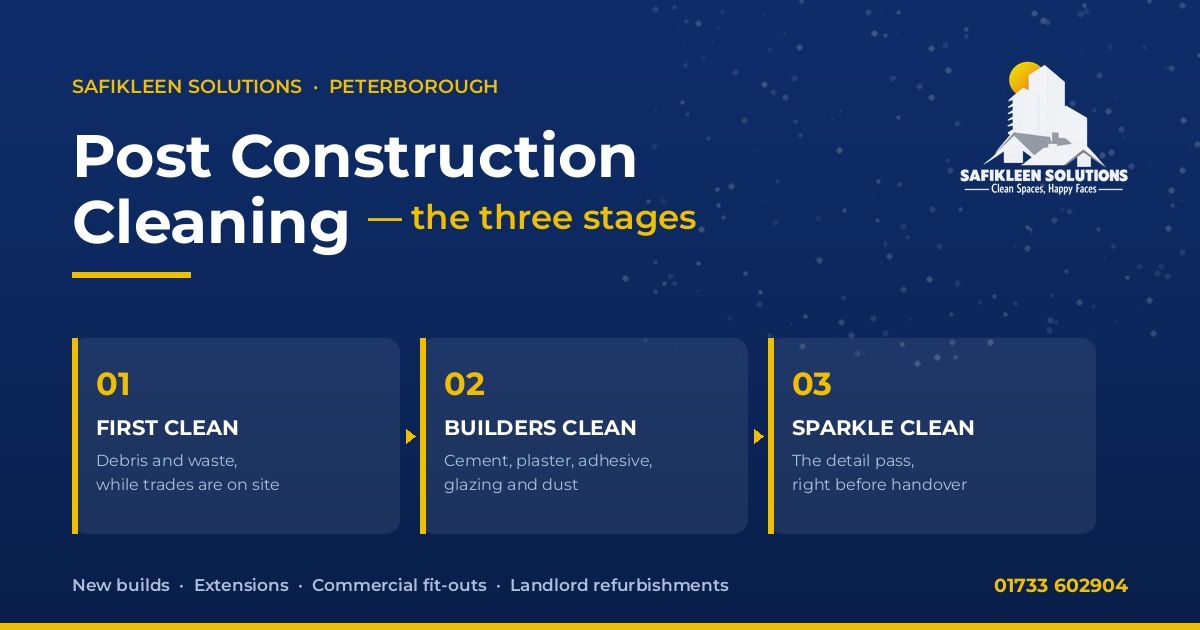
- After builders: £25 to £40 an hour, and almost always more than one visit — our guide to builders cleans explains why a single visit never finishes the job
If you want to see how the specification behind those numbers is built, our guide to office cleaning contracts in Peterborough goes through it task by task, and the commercial cleaning contract buyer guide covers the terms worth arguing about before you sign.
Why some contractors will not quote a small job
If you have a single small office and you are struggling to get anyone to come and look at it, this is why.
Cleaning is a staffing business. A contractor real constraint is not equipment, it is finding a reliable person who will travel to your building for forty-five minutes a night. Below roughly an hour a visit, the travel time starts to exceed the paid time, and the job becomes almost impossible to staff without someone else nearby on the same round.
There are two practical ways round it. Cluster your visits — three longer cleans a week instead of five short ones makes a job that can actually be staffed, and often costs less in total. Or ask whether the contractor already has a round in your part of Peterborough, because a building two streets from an existing client is a completely different proposition to an isolated one.
When your price should go up, and when it should not
Cleaning contracts are usually annual with an uplift clause, and the uplift is where a reasonable contract quietly becomes an expensive one.
Legitimate reasons for an increase: the National Living Wage rising in April, which it does every year and which flows straight through to a labour-led service; a genuine increase in the area being cleaned; added frequency; or added tasks you have asked for.
Reasons worth challenging: a flat percentage applied annually regardless of what actually changed, inflation quoted as a round number with no reference to anything, or an increase arriving at the same time as a reduction in hours on site.
The fair version is a clause that passes through wage increases on the labour element only, and leaves the rest of the price alone unless the scope changes. Ask for the uplift mechanism to be written into the contract at the start. It is a much easier conversation before you sign than eleven months later.
Is VAT on top?
Usually, yes. Any cleaning contractor turning over above the VAT registration threshold charges VAT, and most established ones do. Quotes are normally shown excluding VAT, so check which you are looking at before comparing two of them. If you are VAT registered yourself it is recoverable; if you are a school, a charity or a small unregistered business, it is a real twenty per cent on the bill.
Commercial cleaning across Peterborough and the surrounding area
SafiKleen Solutions provides contract and commercial cleaning across Peterborough, Stamford and the surrounding area — offices, schools, industrial units, retail premises and post-construction work, along with pest control and specialist cleaning.
We will price from a walkthrough rather than a floor plan, put the specification in writing with a frequency against every task, and show consumables and periodic work as separate lines so you can see exactly what you are comparing. If a cheaper way of covering the same building exists, we would rather tell you about it than lose the contract in month four.
Get in touch to arrange a walkthrough and a written quote.
Frequently asked questions
How much does office cleaning cost per hour in the UK?
Between £15 and £25 per cleaner per hour for regular contract work, with most quotes between £18 and £22. London and the South East run higher, commonly £20 to £40. One-off and deep cleans are priced above contract rates, typically £20 to £35 an hour.
Is contract cleaning cheaper than booking one-off cleans?
Per hour, yes, usually by around a third. A contract gives the cleaning company predictable work it can staff properly, and a building that never drifts far from its baseline takes less time each visit. One-off cleans carry the cost of mobilising for a single job.
Does the price include cleaning materials and consumables?
Cleaning chemicals and equipment are almost always included. Consumables — soap, hand towels, bin liners, toilet roll — are frequently not. Ask specifically, because it is the single most common cause of a first-quarter dispute.
How much does it cost to clean a 1,000 square foot office?
About 93 square metres. At £0.15 to £0.40 per square metre per visit that is roughly £14 to £37 per clean, so somewhere around £300 to £800 a month on a five-day schedule depending on specification and consumables. Washroom count will move that figure more than floor area will.
Why are two quotes for the same building so far apart?
Nearly always the specification rather than the rate. Check that both cover the same areas, the same task frequencies, the same consumables arrangement and the same treatment of periodic work. Once those match, the remaining gap is the real price difference, and it is usually small.
How often should a commercial building be cleaned?
Offices with daily occupancy are normally cleaned every weekday, with washrooms serviced daily regardless of anything else. Lower-occupancy sites can run two or three times a week. Below that, each visit gets longer and the cost per visit rises, so the saving is smaller than it looks.
Ready to work with SafiKleen Solutions Limited?
Let's connect! We’re here to help.
Send us a message and we’ll be in touch.
Or give us a call today at 01733 602 904
Agency Contact Form
More Marketing Tips, Tricks & Tools