Builders Clean or Sparkle Clean? What Post-Construction Cleaning in Peterborough Actually Involves
What a builders clean actually covers, how it differs from a sparkle clean, and why construction dust needs a completely different approach.
The builders have gone. The scaffolding came down last week, the skip was collected on Friday, and the job is finished.
Then you open the door, and a grey film is sitting on every windowsill, every socket, every surface. Plaster splashes have dried onto the skirting. There is a fine dust in the air that catches the light. Someone has left a sticker on each new window, and the glue is not coming off with a cloth.
That gap between "the work is done" and "the building is ready" has a name in the trade. It is the post construction clean, and it is routinely the most underestimated line on a project — on a two-bedroom extension in Werrington just as much as on a commercial fit-out off the Peterborough parkways.
Here is what it actually involves, what the different names mean, and why the dust in a newly finished building is not the same as the dust in your living room.
What is a builders clean?
A builders clean — also called an after builders clean — is the deep clean carried out once construction or renovation work finishes, to remove the debris, dust and residue that building work leaves behind and bring a property to a usable, presentable standard.
It is not a bigger version of a domestic clean. The materials are different. A normal clean deals with dirt that has settled. A builders clean deals with material that has been bonded to surfaces — cement splashes, plaster dust that has absorbed moisture and set, silicone smears, paint spots, adhesive from protective film, grout haze on new tiling. These need the right solvent, the right pad and the right sequence, or you scratch the thing you are trying to clean.
It also deals with volume. Construction dust does not stay where it lands. It gets into extract vents, light fittings, the tops of door frames, the channels of sliding doors, and the inside of cupboards that were fitted before the floor was cut. You can clean a room beautifully and have it grey again by morning, because nobody cleaned the ceiling void or the trunking above it.
Builders clean vs sparkle clean: what is the difference?
This is where the terminology gets muddled, and it is worth being clear because you may be quoted for one and expecting the other.
Across the UK industry, the two terms are sometimes used interchangeably — some contractors say "builders clean" and "sparkle clean" to mean the same final deep clean. More often, though, they describe different stages of the same process.
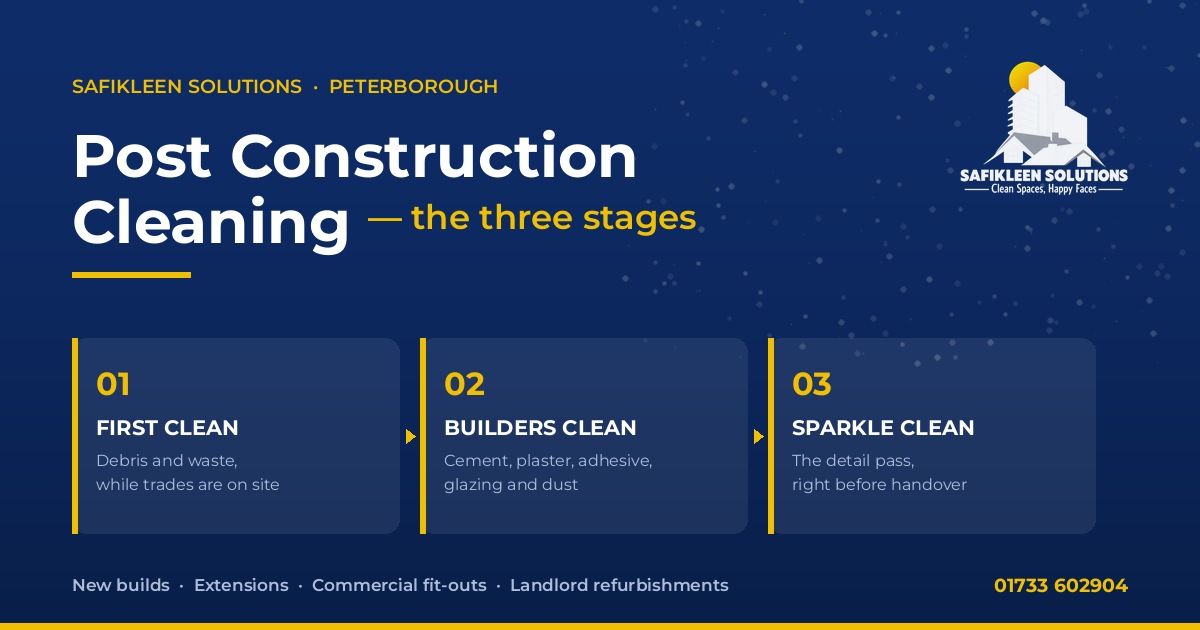
Stage one: the first clean
Also called a rough clean or an initial clean.
- When it happens: while the trades are still on site.
- What it covers: removing debris, offcuts, packaging and bulk waste. Making the site safe and workable. No finishing at all.
Stage two: the builders clean
Also called an after builders clean or a second clean.
- When it happens: once the main trades have finished.
- What it covers: the heavy work. Removing cement, plaster, paint, adhesive and dust from every surface — windows, frames, floors, sanitaryware and fittings.
Stage three: the sparkle clean
Also called the final clean or the handover clean.
- When it happens: immediately before handover or occupancy.
- What it covers: the detail pass. Polishing glass and chrome, removing fingerprints and smears, a final vacuum, and touching up anything marked since the builders clean.
The practical point: a sparkle clean on its own will not rescue a property that has not had a proper builders clean first. If someone quotes you a low price for a "sparkle clean" on a building that still has grout haze on the tiles and plaster on the skirting, they are quoting for the wrong job — and the result will look exactly like a building that has had the wrong job done to it.
The reverse is also true. If handover is three weeks after the builders clean and trades have been back in to snag, you need the sparkle pass as well. Dust re-settles. Fingerprints arrive.
Why construction dust is not ordinary dust
This is the part that gets skipped, and it is the part that matters most.
Construction dust is not simply dirty. Cutting, drilling, grinding and coring concrete, brick, stone, tile and mortar produces respirable crystalline silica — particles small enough to reach deep into the lungs. The Health and Safety Executive is direct about the consequences: breathing this dust can cause silicosis, chronic obstructive pulmonary disease and lung cancer, and these diseases cause permanent disability and early death.
That changes how the clean has to be done, and it is the clearest line between a professional post-construction clean and someone with a broom.
HSE guidance on removing construction dust is specific:
- Dry dust should be vacuumed or removed using wet methods.
- Vacuums should meet at least dust Class M — the medium-hazard classification, with filtration and a sealed disposal system suited to this material.
- Avoid brushes and compressed air. Sweeping and blowing do not remove the dust. They put it back into the air you are standing in, and then it settles again somewhere else.
- Clean up as soon as possible, rather than letting dust accumulate.
If you have watched someone dry-sweep a newly plastered room and then wondered why the dust came back for a fortnight, that is why. A domestic vacuum will not hold this material either — the fine fraction passes straight through the filter and out of the exhaust, which is a very efficient way of distributing silica around a building.
So when you ask a contractor what they will use, "a Class M vacuum" is a meaningful answer. "A hoover" is not.
Who is responsible for cleaning after building work?
In practice this depends entirely on what the contract says, and it is one of the most common disputes at the end of a job.
Most building contracts require the contractor to leave the site "clean and tidy" or to remove their waste and debris. That is not the same as a builders clean. Clearing rubbish and sweeping up is a lower standard than preparing a property for occupation, and a contractor meeting the first obligation has not necessarily agreed to the second.
Three practical positions:
- On a main contract or new build, the clean is usually the contractor's responsibility and is priced into the works. Check whether it covers the builders clean, the sparkle clean, or both.
- On a domestic extension or renovation — the bulk of the building work going on around Peterborough — it is very often neither priced nor discussed, and the homeowner discovers at the end that "clean and tidy" meant the skip is gone.
- On a fit-out or landlord refurbishment, responsibility frequently sits with whoever is taking occupation, which may be the incoming tenant rather than the landlord.
The useful move is to settle it in writing before work starts, naming the standard and the stage. "Builders clean and sparkle clean to be provided by the contractor prior to handover" takes one sentence and prevents a familiar argument.
How long does it take, and what does it cost?
Honestly: nobody can price a post construction clean from a phone call, and anyone who gives you a firm figure without seeing the property is guessing.
What drives the time and the price:
- Floor area and number of rooms — the obvious one, but the least important of these.
- How much finishing is still bonded on. A property where trades protected surfaces properly might take half the time of an identical one where they did not. Grout haze, silicone smears and paint overspray are slow, careful work.
- Glazing. Windows with protective film left on through a hot summer are a job in themselves. The adhesive cures.
- Floor type. New natural stone, polished concrete and engineered timber each need a different approach and the wrong product will damage them permanently.
- Access and stage. Cleaning around trades who are still working costs more and achieves less than cleaning an empty building.
- Whether both stages are needed, or only the final pass.
A site visit takes twenty minutes and turns a guess into a fixed price. It is also when a competent contractor will tell you if your programme is unrealistic — which is more valuable than the quote.
What to ask before you book
Five questions that separate a post-construction specialist from a general cleaner:
- What vacuum classification do you use? Class M or better, for the reasons above.
- Are you quoting for a builders clean, a sparkle clean, or both? Get the stage named on the quote.
- How do you handle new floor finishes? They should ask what the floor is before answering.
- Will you work around trades, or do you need the building clear? Both are possible; the price and the result differ.
- Are you insured for works in progress? Cleaning a building that is still a construction site is a different risk to cleaning an office.
Frequently asked questions
Is a builders clean the same as a deep clean? No. A deep clean addresses accumulated dirt in a building already in use. A builders clean removes construction residue — cement, plaster, adhesive, grout haze, silica dust — which needs different products, different equipment and a different sequence.
Can I do a builders clean myself? You can, but the dust is the problem. Without a Class M vacuum you will move silica around rather than remove it, and domestic vacuums are not built to contain it. The finishing work — grout haze, silicone, adhesive on glass — is also where most DIY attempts leave permanent marks on new surfaces.
How much does an after builders clean cost in Peterborough? There is no standard rate, because the variable that matters is not floor area but how much bonded residue is left on the surfaces. Two identical properties can differ by half the price depending on whether the trades protected the finishes. Any firm quoting over the phone without seeing it is estimating, not pricing.
How soon after the builders finish should it be done? As soon as the trades are genuinely finished and before anyone moves in. Dust that sits gets harder to shift, particularly on anything that has absorbed moisture. If snagging will continue after handover, plan a sparkle pass afterwards.
Do you clean windows as part of a builders clean? Yes — internal and external glazing, frames, sills and tracks, including removal of protective film and adhesive residue, which is usually the slowest part.
Does a builders clean include the outside? It can. Pressure washing paths, patios, driveways and hard landscaping is often needed after a build, as is gutter clearance where roof work has taken place.
Getting it right the first time
A post-construction clean is the last thing that happens to a building and the first thing anyone notices about it. A good build can look unfinished because of grout haze on the tiles. An ordinary build can look immaculate because someone took the glazing seriously.
SafiKleen Solutions provides post construction cleaning and after builders cleaning across Peterborough and the surrounding area, for new builds, extensions, commercial fit-outs and landlord refurbishments — alongside pressure washing, window cleaning, gutter clearance and carpet and hard floor cleaning where a project needs them.
If you have a handover date in the diary, the useful conversation is the one that happens before it, not the week of. Call 01733 602904 or get in touch through the website and we will come and look at the building.
Ready to work with SafiKleen Solutions Limited?
Let's connect! We’re here to help.
Send us a message and we’ll be in touch.
Or give us a call today at 01733 602 904
Agency Contact Form
More Marketing Tips, Tricks & Tools