Why Your Toilet Still Smells After You've Cleaned It
It is not the bowl. It is the three-millimetre gap under the seat hinge, and no weekly clean has ever reached it.
You've bleached the bowl. You've wiped the seat. You've done the floor. And there is still a faint smell in the room that nobody wants to mention.
It is almost never the bowl.
Watch the whole thing, before and after.
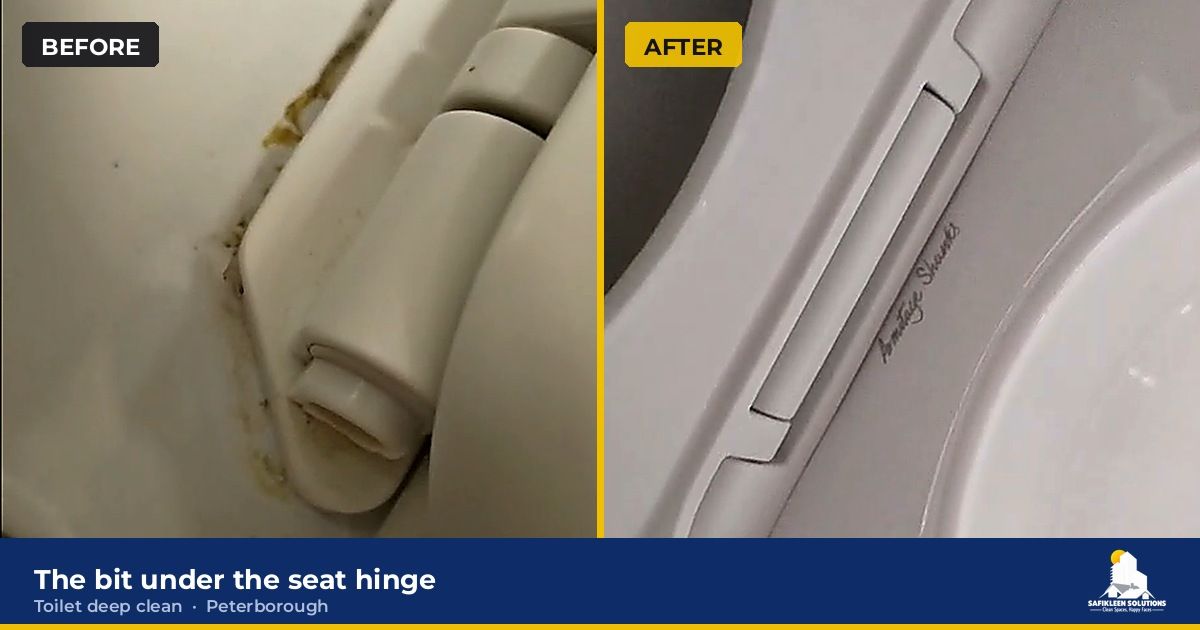
The two photographs in this post are the same toilet in the same Peterborough bathroom, about forty minutes apart. The first is the gap where the seat hinge meets the porcelain. The second is the same spot afterwards — close enough to read the maker's name stamped into the pan, which you could not do before.
Nobody had neglected that bathroom. It was cleaned regularly. It was just cleaned around the hinge, the way almost everyone cleans around the hinge, because the seat is in the way and the gap is about three millimetres wide.
Why the smell survives a clean
A toilet gets cleaned from above. Cloth over the seat, brush in the bowl, spray on the lid. Everything you can see gets attention.
The hinge gap is the one part of a toilet that is both heavily soiled and completely hidden. Every flush throws a fine spray upward. Every use adds to it. The droplets land in the gap between the hinge body and the porcelain, and then they sit there — out of the air, out of the light, and out of reach of any cloth.
That is where the smell lives. The bowl is full of water and gets flushed several times a day. The hinge gap never gets rinsed by anything.
So you can clean a toilet properly, to a standard you would be happy for anyone to inspect, and still walk back into the room an hour later and catch it.
What the yellow staining actually is
The colour in the first photograph is the giveaway. That yellow-brown crust around the fitting is not dirt in the ordinary sense, which is why ordinary wiping does not shift it.
It is a mineral deposit. Urine contains dissolved salts; when the liquid evaporates, the salts are left behind and bond to the surface. Over months they build into a hard scale that has bacteria living in it, and because it has chemically attached itself to the porcelain, a damp cloth slides straight over the top of it.
That is also why bleach often disappoints here. Bleach is good at killing what is on a surface and poor at removing something that has crystallised onto it. You need something acidic to dissolve the mineral, and then you need to physically get at it — which brings us to the awkward part.
Does the toilet seat come off?
On most seats made in the last fifteen years or so, yes — and far more easily than people expect.
Modern seats commonly use quick-release hinges. The hinge covers flip open, there is a push-button or a sliding catch inside, and the whole seat lifts straight up off two mounting posts that stay bolted to the pan. No tools, no removing nuts, usually under thirty seconds.
If yours does not have that, it will be bolted on — either top-fixed, where the bolt heads are visible on top of the pan, or bottom-fixed, where there is a nut underneath. Those come off too, with a screwdriver or a spanner, just more slowly.
Either way, the seat coming off is what turns a ten-minute job into a job that actually works. With the seat off, the hinge footprints, the post bases and the whole area around them are open, flat and reachable.
How to do it properly
The order matters more than the products.
- Take the seat off. Quick-release catch, or unbolt it. Put it somewhere it can be cleaned on both sides.
- Treat the deposit, don't scrub it. Apply a limescale remover or a suitable acidic bathroom cleaner to the hinge footprints and the post bases, and leave it to sit. The dwell time is the part people skip, and it is the part doing the work.
- Agitate, then rinse. An old toothbrush around the posts and into the seam. Rinse properly rather than wiping the residue around.
- Do the underside of the seat and the hinge bodies themselves. The underside of a seat usually has its own deposits, and the hinge bodies have a seam that collects the same material.
- Refit and check from seated height. Looking down from standing hides exactly the area you have just cleaned.
A note worth making: never mix bleach with an acidic or limescale product. The combination releases chlorine gas. Use one, rinse thoroughly, then use the other if you want to — not both at once.
Why this is worse in Peterborough
Peterborough sits in a hard water area, and that changes the problem.
Hard water means every drop that evaporates leaves calcium and magnesium behind as well. Those minerals bind with the deposits already in the hinge gap and set harder than they would in a soft water area. The same bathroom in Manchester would build the same deposit more slowly and release it more easily.
It also explains why the scale comes back faster than you expect after you have finally shifted it. You are not doing it wrong. The water is simply depositing minerals every single day.
How often does this need doing?
For a normal household bathroom, lifting the seat off and treating the hinge area properly two or three times a year keeps it from ever reaching the state in the first photograph. In a hard water area like Peterborough, nearer three than two.
In a busy family bathroom, or any toilet used by several people a day, every couple of months is more realistic. In rented property it should be part of every end of tenancy clean, because it is one of the specific places a letting agent will look — and one of the few that genuinely cannot be faked.
Frequently asked questions
Why does my toilet smell even though it looks clean? Almost always the gap between the seat hinge and the porcelain. It collects spray from every flush, never gets rinsed, and cannot be reached with the seat attached. Clean around it for years and it keeps developing.
What is the yellow stain around the toilet seat fittings? Mineral deposit from evaporated urine, hardened onto the surface and usually bound up with limescale in a hard water area. Because it is crystallised rather than merely dirty, wiping does not remove it — it needs an acidic product and dwell time.
Can I just use bleach? Bleach will disinfect but it will not dissolve a mineral deposit, so the stain and the smell come back. Use a limescale or acidic bathroom product for the deposit itself, and never combine the two.
Will removing the seat damage it? Not if it is quick-release — that is precisely what the mechanism is for. Bolted seats are also designed to be removed; the fittings are intended to come apart for replacement.
Do professional cleaners take toilet seats off? A deep clean should include it. A routine weekly clean usually will not, and should not be expected to — it is a different job at a different frequency.
Is this part of an end of tenancy clean? It should be. Toilet fittings are a standard inspection point, and the hinge area is one of the places where a surface clean is obvious to anyone who looks.
The short version
If a bathroom smells and you cannot find the source, take the seat off before you do anything else. In most cases you will find it in under a minute.
SafiKleen Solutions provide house cleaning in Peterborough and the surrounding area — deep cleans, regular housekeeping, end of tenancy cleaning, and contract cleaning for offices, schools, gyms and retail premises.
If there is a bathroom in your house or your workplace that never quite smells clean, call 01733 602904 or get in touch through the website and we will come and find it.
Ready to work with SafiKleen Solutions Limited?
Let's connect! We’re here to help.
Send us a message and we’ll be in touch.
Or give us a call today at 01733 602 904
Agency Contact Form
More Marketing Tips, Tricks & Tools