Why a Mopped Floor Still Looks Dull
Munyovi Victor IndiaziGrout, mop water and detergent film — the three reasons daily mopping stops keeping up, and what resets a hard floor.
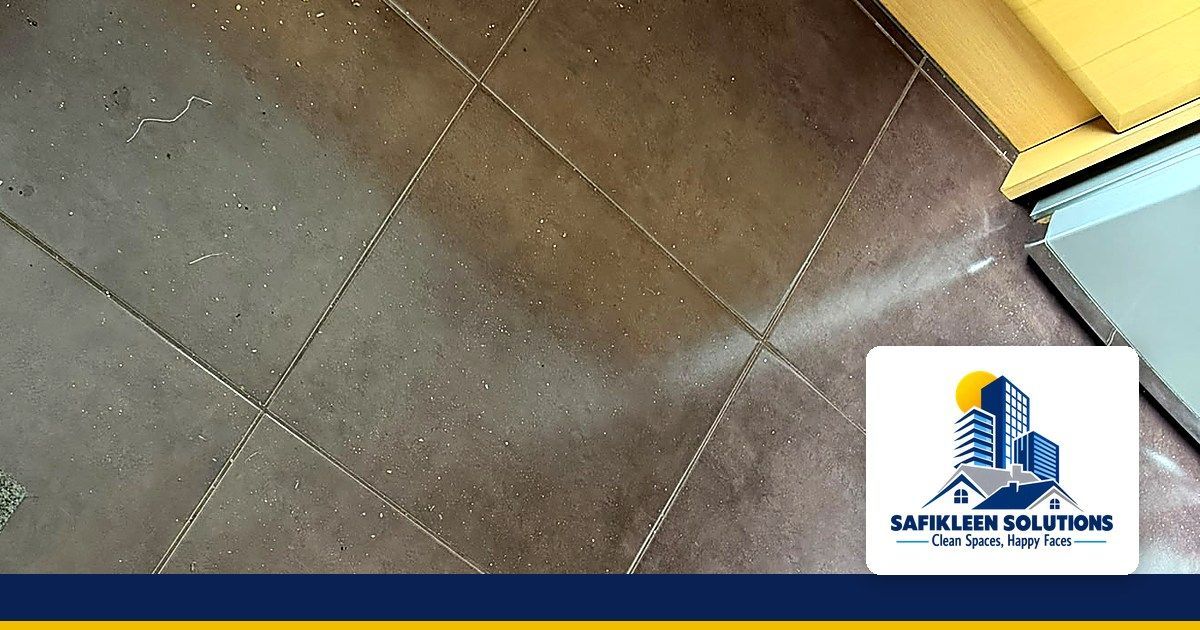
A hard floor can be mopped every day and still look grey. Not dirty exactly, and not obviously neglected — just flat, dull, slightly cloudy, never quite the colour it was when it went down. The usual response is to mop it more often, which is the one thing that reliably fails to work.
The mop is not really the problem. The problem is the gap between what a mop can reach and what a floor actually holds, and once you know where that gap is, most dull floors explain themselves.
Why does a mopped floor still look dull?
Because three different things are happening, and only one of them is dirt.
Soil collects in the grout, where a mop cannot properly get at it. Mop water turns into a weak dirt solution partway through the job and starts putting soil back down instead of taking it away. And detergent that is never rinsed off leaves a film which builds, layer on layer, into a haze.
Each one on its own is mild. Together, repeated daily for a year, they are the difference between a floor that looks maintained and one that looks tired.
What is actually in the grout?
Everything the tile has shed, because grout sits lower than the tile and is porous where the tile is not.
On most floors the grout line is set one to three millimetres below the face of the tile. A flat mop head bridges straight across that gap and barely touches the bottom of it. So while the tile face gets cleaned, the grout quietly accumulates, and because grout is cement-based and absorbent it holds onto what lands in it rather than releasing it to the next pass.
This matters more than it sounds because of how a floor is viewed. Nobody looks at a floor from above. You see it at a shallow angle from standing height, which compresses the grout lines together visually and hides most of the tile. A floor with clean tiles and dirty grout reads as a dirty floor, and no amount of attention to the tiles will change that.
Why does the last room always look the worst?
Because of what is in the bucket by the time you get there.
A mop does not destroy soil, it transfers it to the water. After a couple of rooms that water is a dilute solution of everything the floor had on it, and every subsequent dunk reloads the mop with a thin film of it. Past a certain point the mop stops removing and starts spreading, and the floor dries with a faint even layer of what used to be in the first room.
The fix is unglamorous: change the water far more often than feels necessary, or use two buckets so the dirty rinse never goes back into the clean solution. In a commercial setting it usually means a fresh solution per area rather than per building, which is one of the things a written cleaning schedule should specify rather than leave to whoever is holding the mop.
What is the grey haze that will not come off?
Detergent, in most cases, rather than dirt.
General-purpose floor cleaners contain surfactants and, often, water-soluble polymers that are designed to dry to a slight shine. Used as directed with a rinse, that is fine. Used daily at a generous dilution and never rinsed, each pass leaves a trace, and traces stack. After a few months the floor has a soft cloudy layer on it which looks exactly like ingrained dirt and behaves nothing like it: mopping adds to it rather than removing it.
You can test for it. Clean a small patch with a neutral cleaner and plenty of clean water, let it dry fully, and look across it at a low angle in daylight. If the patch is noticeably clearer than the floor around it, you are looking at build-up, and the floor needs stripping or a deep clean with a rinse rather than another mop.
Does the mop itself make a difference?
More than almost anything else in the routine.
A flat microfibre head picks up and holds fine soil far better than a string mop, which mostly pushes water. But microfibre only works while there is somewhere for the soil to go, and a head that has been used across a whole floor is saturated and doing very little. Heads should be changed by area, not by day, and washed without fabric conditioner, which coats the fibres and kills the very property that makes them work.
A string mop still has its place on heavily textured or uneven floors where a flat head cannot make contact, but it needs wringing properly and the water changing more often, not less.
How wet should a floor actually be?
Damp, not wet. The floor should be dry within a few minutes.
Over-wetting is one of the commonest faults and it causes three separate problems. Standing water sits in the grout lines long enough to soak in, carrying dissolved soil with it. More water means more dissolved detergent left behind as it evaporates, which feeds the haze described above. And on a floor with any gap in it — an unsealed joint, a cracked tile, a worn threshold — water finds its way to the adhesive bed or the subfloor underneath, where it does slow damage that nobody sees for years.
A floor that is still visibly wet five minutes after mopping is also a slip risk, which is a separate and more immediate problem.
Sealed or unsealed: why it changes everything
Because the question is whether the floor can absorb what you put on it.
Glazed ceramic and porcelain are effectively non-porous. What lands on them stays on the surface and can be removed. Natural stone, terracotta, unglazed quarry tile, polished concrete and the grout on any floor are porous to some degree, and anything spilled on them soaks in. On those floors an impregnating sealer is not a finish or a shine, it is a barrier that buys you time to wipe a spill up before it becomes a stain.
Sealer wears, particularly along walkways, which is why a floor often stains readily in the middle of a room and not at the edges. If water dropped on the surface darkens the stone within a minute or two rather than beading, the seal has gone and cleaning alone will not restore the appearance.
Why acidic cleaners ruin some floors
This one causes permanent damage and it is worth being precise about.
Limescale is alkaline, so limescale removers are acidic. That is fine on porcelain, ceramic and most vinyl. It is not fine on limestone, marble, travertine or terrazzo, all of which are calcium-based: the acid reacts with the stone itself, etching a dull patch into the polish that cannot be cleaned off because nothing has been deposited. The surface has been removed. Restoring it means re-honing and re-polishing the stone.
The same applies to cement-based grout, which is why a strong acidic cleaner used repeatedly on a tiled floor can leave the grout soft, open and faster to dirty than it was before. If the floor is stone, or you are not sure what the floor is, neutral pH is the only safe starting point.
What does machine scrubbing do that a mop cannot?
Three things, and they are the three that matter.
It applies consistent mechanical agitation across the whole surface, including down into the grout line, which is the part a mop bridges over. It keeps the cleaning solution working on the floor for long enough to do its job rather than being wiped away immediately. And on a machine with extraction, it removes the dirty solution from the floor entirely instead of leaving it there to dry.
That last point is the real difference. A mop finishes a floor by spreading its own dirty water thinly and letting it evaporate. Extraction takes the soil off the premises. It is why a floor that has been scrubbed and extracted looks different in a way that is hard to achieve by hand, and why a deep clean once or twice a year makes the daily routine work better for months afterwards. We go into the wider principle in our guide to what a deep clean removes that a weekly clean leaves behind.
How often does a hard floor need more than a mop?
It depends almost entirely on traffic, and the honest answer is a range.
A domestic kitchen or bathroom generally wants a deep clean with grout attention twice a year. A busy office or a reception area with external footfall coming straight onto it is closer to quarterly. A school corridor, a gym changing room or a food preparation area may need it monthly, because the soil arriving each day exceeds what a daily routine can take away.
The signal to watch is the grout rather than the tile. When the grout lines have gone a shade darker than they were and stay that way after a normal clean, the daily routine has stopped keeping pace, and more of the same will not catch up. Our carpet and hard floor cleaning works to that cycle rather than to a fixed calendar.
Why floors after building work are a different job
Because the soil is mineral rather than organic, and water makes most of it worse.
Plaster and cement dust turns to slurry the moment it meets a wet mop, and that slurry runs into every grout line and dries there as a pale film. The correct order is to remove the dust dry — vacuum thoroughly, including edges and corners — before any water goes near the floor. Mopping first simply relocates the problem into the joints.
Grout haze, the cloudy film left after tiling, is a separate issue again: it is cement residue, it does not respond to ordinary detergent, and it needs either a dedicated haze remover on an acid-safe tile or mechanical removal on stone. Getting that sequence wrong is one of the commonest reasons a brand new floor looks disappointing, and it is the reason post-construction cleaning is specified separately from ordinary cleaning rather than treated as a thorough version of it.
What should be written down
If a floor is being cleaned under a contract, the method should exist on paper before anyone starts.
Which product and at what dilution. Whether there is a rinse pass. How often the water and the mop head are changed. Who is responsible for the grout and how often. What happens to the floor after building work or a spillage. These are the details that decide how a floor looks in two years, and they are exactly the details that get lost when cleaning is agreed verbally. The same logic applies to every other part of a building, which is why our guide to office and contract cleaning in Peterborough sets the whole thing out as a specification rather than a promise.
It matters at the other end of a tenancy too. A floor is one of the first things an inventory clerk looks at, and grout is one of the easiest things to be charged for, which is where an itemised end of tenancy clean earns its money.
Hard floor cleaning in Peterborough
SafiKleen Solutions clean and maintain tiled, vinyl, stone and polished concrete floors for homes, offices, schools and rented properties across Peterborough and the surrounding area, alongside contract cleaning, post-construction cleaning and end of tenancy work.
In practice that means identifying what the floor is before choosing what goes on it, scrubbing and extracting rather than spreading, giving the grout separate attention, and telling you plainly which marks are soil and which are etching, wear or damage in the surface itself. Where a floor has lost its seal or been etched by the wrong product, cleaning will improve it and will not restore it, and that is better said at the quote than discovered at the end.
If a floor is being cleaned regularly and still does not look right, that is the visit to book. You can see the full range of what we cover, or get in touch to arrange a look round and a written quote.
Ready to work with SafiKleen Solutions Limited?
Let's connect! We’re here to help.
Send us a message and we’ll be in touch.
Or give us a call today at 01733 602 904
Agency Contact Form
More Marketing Tips, Tricks & Tools