What a Deep Clean Removes That a Weekly Clean Leaves Behind
Munyovi Victor IndiaziLimescale, grease, and the order of work — why some marks survive every wipe, and what actually shifts them.
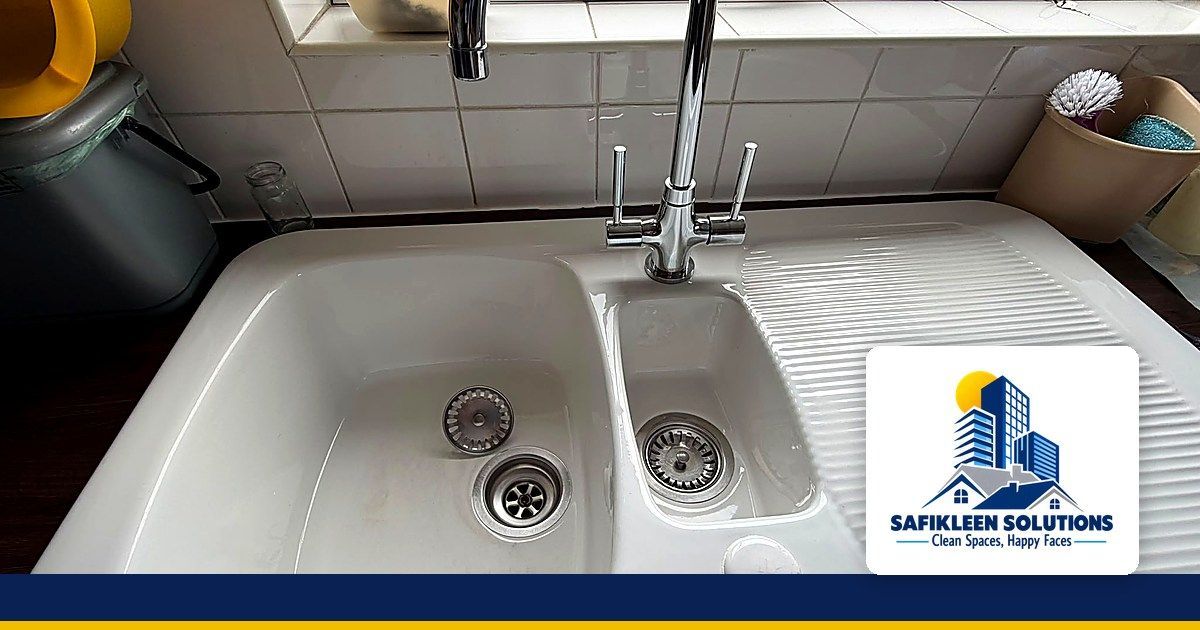
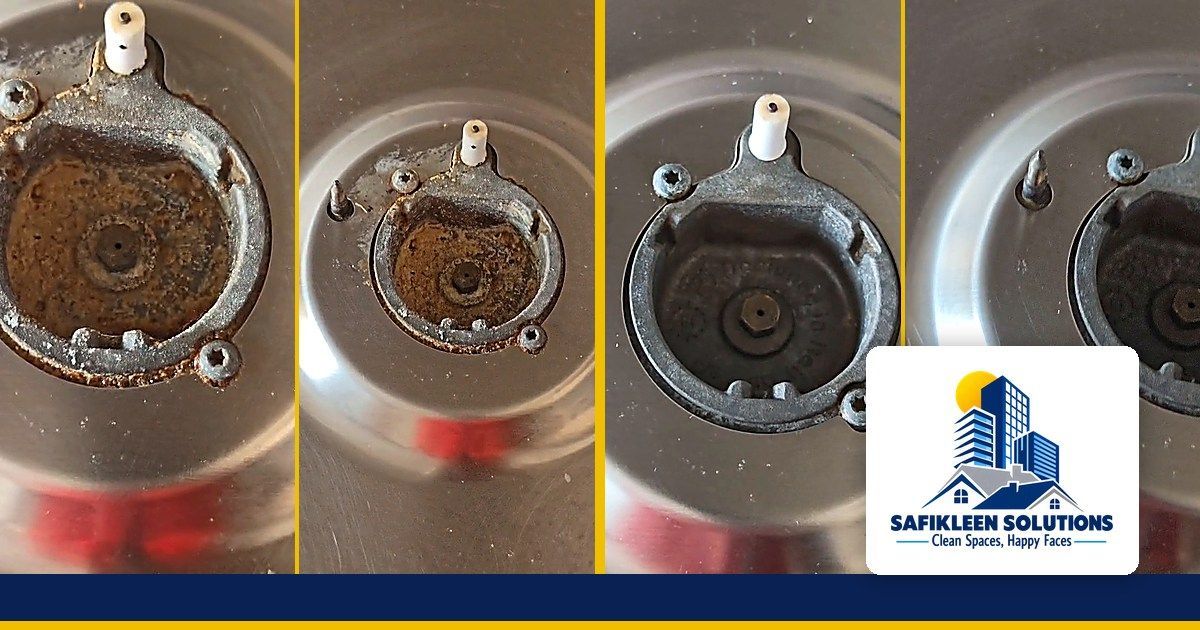
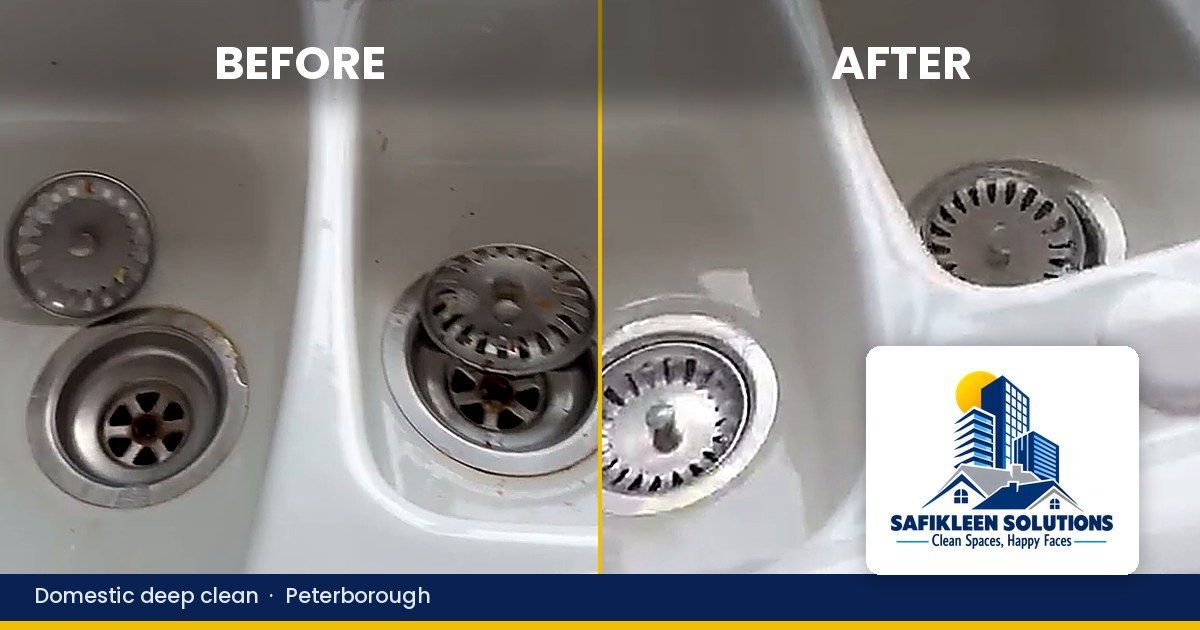
Kitchen and bathroom, filmed before and after during a home deep clean in Peterborough. Watch on LinkedIn.
You can tell how a property has been cleaned by looking at one thing: the sink. Not the worktops, which get wiped every day by whoever lives there, and not the floor, which shows dirt so obviously that it gets dealt with. The sink, and specifically the ring around the waste, because that is where the two kinds of soil that a weekly clean cannot touch end up sitting together.
A regular clean removes what has landed on a surface. A deep clean removes what has bonded to it. Those are different jobs, needing different chemistry and a different amount of time, and confusing the two is why people scrub at a mark for twenty minutes and get nowhere.
What is the difference between a regular clean and a deep clean?
A regular clean is about what has arrived since last time. Crumbs, dust, splashes, fingerprints, whatever came in on shoes. It is surface work, it is fast, and done consistently it keeps a property in good order indefinitely.
A deep clean is about what did not leave. Every regular clean leaves a thin residue behind — the fraction of the grease that the cloth smeared rather than lifted, the film of minerals the water left as it dried, the soap that bonded with those minerals into something neither water nor detergent shifts. Individually these are invisible. Cumulatively, over months, they are what makes a kitchen look tired while being technically clean.
The practical test is simple. If a surface comes clean when you wipe it, it needed a regular clean. If it looks the same after wiping as it did before, whatever is on it is bonded, and wiping harder will not change that.
Why does limescale come back in exactly the same shape?
Because it is not dirt landing randomly. It is a deposit forming where water sits and evaporates, which is always the same place.
Hard water carries dissolved calcium and magnesium. When it evaporates, those minerals stay on the surface as a crystalline film. Around a waste, at the base of a tap, along the tide line of a bath, water sits a little longer than everywhere else, so the deposit builds there first and thickest. The reason it reappears in the same ring after a wipe is that a wipe removes the loose grime sitting on top of the scale while leaving the scale itself, and the scale is what is holding the colour.
Scale is alkaline, which means detergent — also alkaline — does almost nothing to it. What dissolves it is acid: a proprietary descaler, or in mild cases the household version. The chemistry does the work, not the arm.
Grease needs the opposite chemistry
Which is the part that trips people up, because the two problems often sit a few inches apart.
Cooking grease is an oil that has oxidised and polymerised — gone from liquid to a varnish-like film, especially above a hob where heat has helped it along. Acid does not touch it. What breaks it down is an alkaline degreaser, which saponifies the fat, turning it into something water-soluble that can be rinsed away.
So a kitchen needs both, used in different places, and used one at a time. Acid on the sink and the tap, alkali on the extractor hood, the splashback above the hob and the oven. Mixing them, or using them on top of one another without rinsing in between, neutralises both and wastes the visit.
Why one spray cannot do a whole kitchen
An all-purpose cleaner is formulated to be adequate everywhere rather than good anywhere. It is mildly alkaline, which makes it reasonable on light grease and food soil — most of what a daily wipe deals with.
Against bonded soil it runs out of road. It will not shift scale because it is on the wrong side of the pH scale, and it will not shift burnt-on grease because it is nowhere near concentrated enough. People then conclude the surface is stained permanently when the real problem is that the right product was never used on it.
This is most of what separates a professional deep clean from a determined weekend. Not effort, and not secret products: just the right chemistry applied to the right soil, in an order that does not cancel itself out.
Dwell time is the part everybody skips
Spray, wipe, move on. That sequence is responsible for more disappointing results than any other single habit.
Cleaning products are reactions, and reactions need time. A descaler needs several minutes in contact with the scale to break it down. A degreaser needs long enough to penetrate the film and lift it off the substrate. Sprayed and immediately wiped, both are removed before they have started, and the surface gets the mechanical effect of the cloth and nothing else.
Leaving a product to dwell also means less scrubbing, which matters more than it sounds: on enamel, chrome and acrylic, aggressive scrubbing leaves fine scratches that hold dirt, so the surface gets harder to clean each time it is attacked. Chemistry and patience protect the finish. Abrasives and effort slowly destroy it.
What does clean mean on a surface that is already damaged?
An honest question, and one worth settling before anyone starts.
Enamel that has been scoured for years is no longer smooth. Chrome that has had limescale sitting on it for a long time can be pitted underneath. Grout that has never been sealed has absorbed staining into the body of the material rather than onto its face. In each case the surface can be taken back to properly clean, but properly clean will not look new, because the damage is in the material and not on it.
A good cleaner will say so before starting rather than after, and will tell you which marks are soil and which are the surface itself. The ones that are soil will come off. The ones that are the surface will not, no matter how long anyone spends on them.
The order of work, and why it is always top down
Gravity decides the sequence, and ignoring it means doing jobs twice.
High surfaces first — tops of cupboards, extractor hoods, shelves, light fittings — because everything disturbed up there falls. Then worktops and mid-level surfaces. Then the wet areas, sinks and basins and baths, which need dwell time and will be rinsed anyway. The floor last, after everything that was going to land on it already has.
The same logic applies room to room in a property: the room furthest from the door first, working back, so nobody walks across a finished floor. It sounds obvious written down. It is also the first thing that gets abandoned when someone is working quickly, and it is why a kitchen can be cleaned thoroughly and still have dust across the floor at the end.
Where the dirt actually accumulates in a kitchen
Not where it is most visible. A short list covers most of what a deep clean finds:
- The seal between worktop and splashback. Water sits in that line, and it is the first place a kitchen starts to smell.
- Under and behind the appliances. The gap beside a washing machine or fridge collects everything that has ever been dropped near it.
- The underside of the extractor and its filter. A saturated grease filter stops extracting and starts dripping.
- Cupboard door tops and handles. Handles get touched with cooking hands every day; the top edge of a door is a horizontal surface nobody looks at.
- The waste and overflow. Where scale, soap and food residue combine into the ring that no amount of wiping removes.
None of these are hard to clean. They are simply never reached by a clean that is organised around what can be seen from standing height.
Bathrooms: three things account for most of it
Scale, soap scum and mould, and they behave differently enough to need separating.
Scale is the mineral deposit described above, and it wants acid and time. Soap scum is scale's compound form — the minerals in hard water reacting with soap to form an insoluble film on tiles, screens and bath sides — and it also responds to acid, though a heavy build-up usually needs two passes rather than one heroic one. Mould is biological rather than chemical: it is living in the silicone and the grout, so surface bleaching removes the colour while leaving the growth, which is exactly why black lines reappear in the same places a few weeks later. Where mould has rooted deeply into a sealant bead, replacing the bead is the repair. Cleaning it is a holding measure.
Ventilation is the part that decides whether any of it stays fixed. A bathroom that cannot dry out between uses will grow mould again whatever is done to the surfaces.
How often does a property need a deep clean?
It depends almost entirely on how good the regular clean is, which is why the honest answer is a range rather than a number.
A property kept to a decent weekly routine generally wants a deep clean twice a year, with the kitchen and bathroom on that cycle and everything else following when it needs to. A busy household, a kitchen that is cooked in properly every day, or a hard water area will push that to three or four times a year. A property where the routine has lapsed needs one deep clean to establish a baseline, after which the regular clean has something to maintain.
That last point is the one worth holding on to. A deep clean is not a substitute for regular cleaning and does not compete with it. It resets the surfaces so that ordinary cleaning starts working again. We have written about the same question from the commercial side in how often your office should really be cleaned, and the logic is identical.
What about end of tenancy?
Different standard, and worth knowing before the keys change hands.
An end of tenancy clean is measured against the inventory taken at the start, not against how the property looks. That means the oven, inside the cupboards, inside the appliances, the window interiors, the extractor filter, behind what can reasonably be moved — the places a normal deep clean might reasonably leave and a check-in report will not. It is the main reason deposits are disputed, and the main reason an itemised clean is worth more than a thorough one with nothing written down.
Our end of tenancy cleaning works to that list rather than to a general impression, and the same applies to post-construction cleaning, where the soil is fine dust rather than grease and needs a completely different approach again.
What you should expect to be told
A deep clean is a visit with a defined scope, and the scope should exist in writing before anyone arrives.
What is included, what is excluded, how long it is expected to take, and which marks have been identified as damage rather than soil. Where the answer to something is "this will improve but not disappear", that should be said at the quote and not discovered at the end. The full range of what we cover is set out on our services page, and hard floors in particular have their own methods, covered under carpet and hard floor cleaning.
Deep cleaning in Peterborough
SafiKleen Solutions carry out deep cleans for homes, offices, schools and rented properties across Peterborough and the surrounding area, alongside regular contract cleaning and end of tenancy work.
In practice that means turning up with the right chemistry for the soil that is actually there, giving it time to work rather than scrubbing the finish off a surface, and working in an order that does not undo itself. It also means telling you plainly which marks are coming out and which ones are the surface itself.
If a kitchen or bathroom has reached the point where the regular clean is no longer making a difference, that is the visit to book. Get in touch to arrange a look round and a written quote.
Ready to work with SafiKleen Solutions Limited?
Let's connect! We’re here to help.
Send us a message and we’ll be in touch.
Or give us a call today at 01733 602 904
Agency Contact Form
More Marketing Tips, Tricks & Tools