Why Your Washing Machine Needs a Deep Clean (Not Just a Quick Wipe)
What's really hiding in the drum, the door seal and the detergent drawer — and why a deep clean reaches what a quick wipe or vinegar rinse can't.
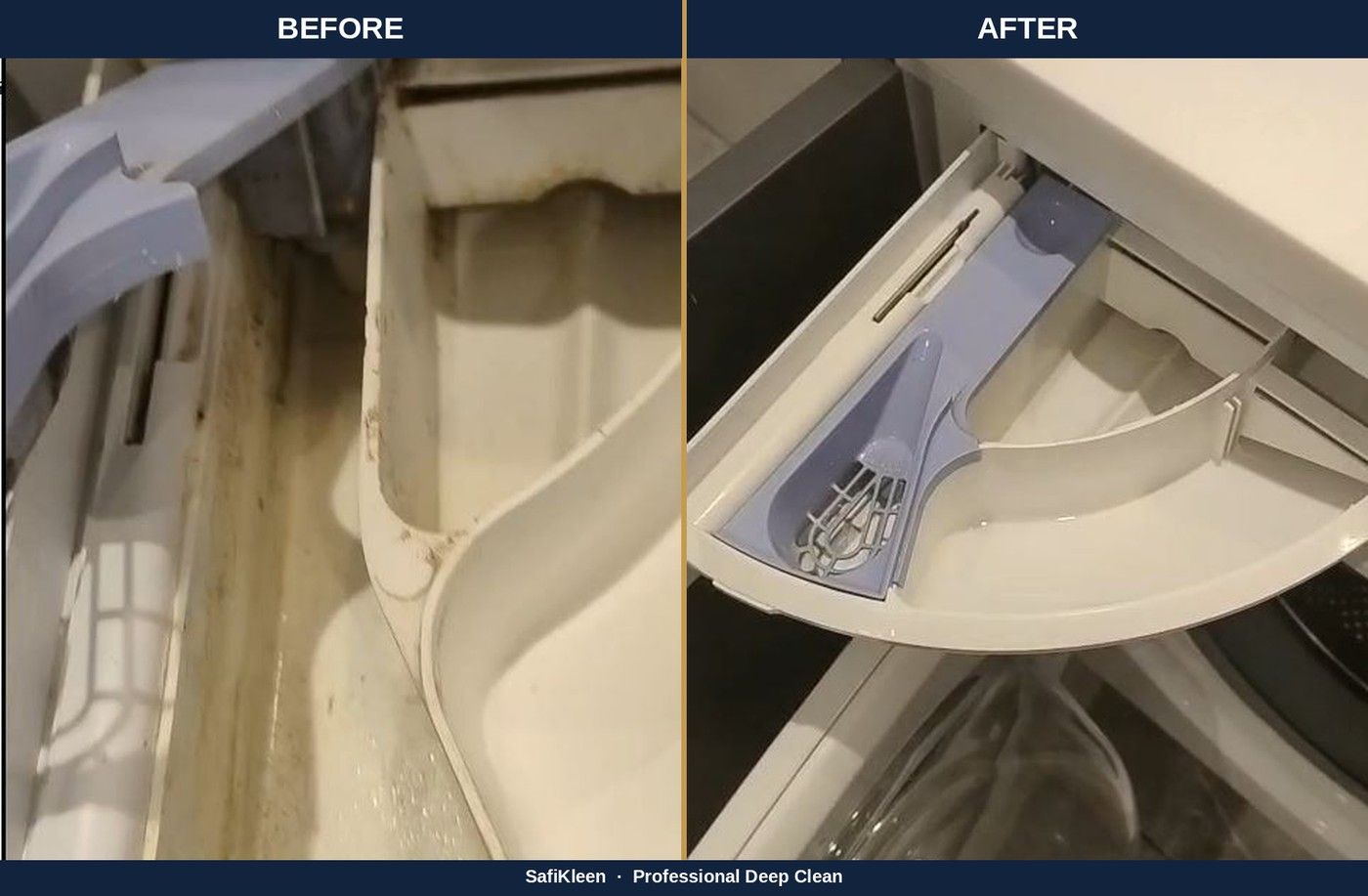
Every wash cycle is meant to leave your clothes clean. But the machine doing the cleaning rarely gets cleaned itself — and over time, that gap catches up with it. The photos above show a real domestic washing machine before and after a deep clean: a build-up of dark, greasy residue lodged in the fold of the rubber door seal, and a detergent drawer coated in limescale and mould around the fabric softener chamber. Below is why the inside of a washing machine gets this way, why it matters, and why a wipe-down or a vinegar rinse only ever deals with the surface of the problem.
What's actually going on inside a washing machine
A washing machine is, by design, a warm, damp, enclosed space that regularly comes into contact with detergent, fabric softener, fibres, skin cells, and whatever was on your clothes before they went in. Every one of those leaves a residue.
Modern low-temperature washes — the 30°C and 40°C cycles most people use for most of their laundry — are efficient and better for fabrics and energy bills, but they don't get hot enough to fully dissolve detergent residue or kill off the bacteria and mould spores that build up inside the drum, the door seal, and the detergent drawer. Over weeks and months, that residue combines with limescale (a particular issue in hard water areas) and trapped moisture to form a biofilm — a sticky layer that mould and bacteria thrive in.
The parts a normal wash never reaches
Three areas are the most common culprits, and they're also the ones a standard cycle — or even a dedicated drum clean programme — doesn't fully reach.
The door seal fold. The rubber gasket around the drum door has an inner lip that sits against the glass. Water, lint, and detergent collect in that fold and rarely fully dry out between washes, which makes it the single most common place for mould to establish itself.
The detergent drawer and its housing. The drawer itself can be pulled out and rinsed, but the channel it sits in — where powder, liquid detergent, and fabric softener are diluted and flushed through — is far harder to reach, and is exactly where the build-up in the photo above was found.
The drum holes and outer drum. The steel drum you see when you open the door has thousands of small holes leading to the outer drum, which stays wet between cycles and is essentially inaccessible without dismantling part of the machine.
Why this matters beyond appearance
It's tempting to treat this as a cosmetic issue, but it has three real consequences.
Hygiene. Clothes that come out of a machine with a mould or bacteria build-up aren't as clean as they look. This matters more for towels, bedding, underwear, gym kit, and baby clothes than for anything else, since these items are washed to remove bacteria in the first place, not just visible dirt.
Odour. The musty smell that develops in towels or the inside of the machine itself, even right after a wash, is almost always down to this kind of build-up rather than the detergent or the wash cycle being wrong.
Performance and lifespan. Limescale and residue affect heating elements, seals, and drainage over time, which can mean less efficient washes, longer cycles, and, eventually, costly repairs or a shortened lifespan for the machine.
Why a wipe-down or a vinegar rinse isn't enough
A lot of the advice around keeping a washing machine clean — running an empty hot cycle with vinegar, wiping the seal with a cloth, leaving the door open between washes — is genuinely useful as regular maintenance. It slows the build-up down. What it doesn't do is remove residue that has already worked its way into the fold of the seal, the drawer housing, or the drum holes, because those spots aren't reachable with a cloth and aren't fully flushed out by a standard cycle, however hot.
That's the difference between maintenance and a deep clean: maintenance keeps a clean machine clean for longer; a deep clean physically removes build-up that has already formed in the parts you can't easily see or reach, restoring the machine to a genuinely hygienic condition rather than just a fresher-smelling one.
How often does it need doing
For most households, a light maintenance routine (empty hot wash, seal wipe-down, drawer rinse) every few weeks is enough to slow build-up down. A proper deep clean of the seal, drawer housing, and drum is generally worth doing every six to twelve months, and more often in hard water areas, in machines used daily, or in machines that regularly run low-temperature cycles.
If it's been longer than that, or you've noticed a musty smell that doesn't go away after a wash, there's a good chance the machine looks closer to the before photo above than the after one.
Doing it properly, without harsh chemicals
Reaching for neat bleach is the instinct a lot of people have once they see build-up like this, but it isn't necessary and it isn't kind to rubber seals, hoses, or the environment over repeated use. The build-up shown above is organic — detergent residue, limescale, and biofilm — and responds well to the right cleaning agents used correctly and left in contact with the affected areas for long enough to actually break it down, rather than a quick spray and wipe. Getting the door seal fold, drawer housing, and drum properly clean is more about technique, the right products, and reaching the areas that are normally hidden than it is about cleaning strength.
Frequently asked questions
Why does my washing machine still smell musty after I clean it?
Because the odour is usually coming from the door seal fold or the detergent drawer housing, not the parts of the drum you can see and wipe. A surface clean or an empty hot wash can mask the smell temporarily without removing the build-up causing it.
Can mould in a washing machine actually make you ill?
Mould and bacteria transferred onto laundry are more of a concern for skin irritation, allergic reactions, and general hygiene than serious illness for most healthy people, but it's a real issue for households with babies, allergy sufferers, or anyone immunocompromised, and it's avoidable.
Does living in a hard water area make this worse?
Yes. Hard water leaves limescale behind on every wash, which combines with detergent residue to speed up build-up in the drum, seal, and drawer. Areas like Peterborough sit in a moderately hard water zone, which is one reason deep cleans are worth doing on a regular schedule rather than only when a smell appears.
Is a washing machine deep clean different from a normal drum clean cycle?
Yes. A drum clean or self-clean programme flushes the drum itself at a high temperature, which helps, but it doesn't dismantle or hand-clean the door seal fold or the detergent drawer housing — the two areas shown in the photos above, and the two areas most machines actually need attention in.
Ready to work with SafiKleen Solutions Limited?
Let's connect! We’re here to help.
Send us a message and we’ll be in touch.
Or give us a call today at 01733 602 904
Agency Contact Form
More Marketing Tips, Tricks & Tools